← Back to Education


Cryogenic Boiling: Heat Transfer
Summary:
- - Investigated the use of liquid nitrogen as a cryogenic fuel, focusing on its low freezing and boiling points, abundance in the atmosphere, and inert nature
- - Addressed challenges in implementation due to the lack of consistent pool boiling data, crucial for safe storage and usage as a fuel
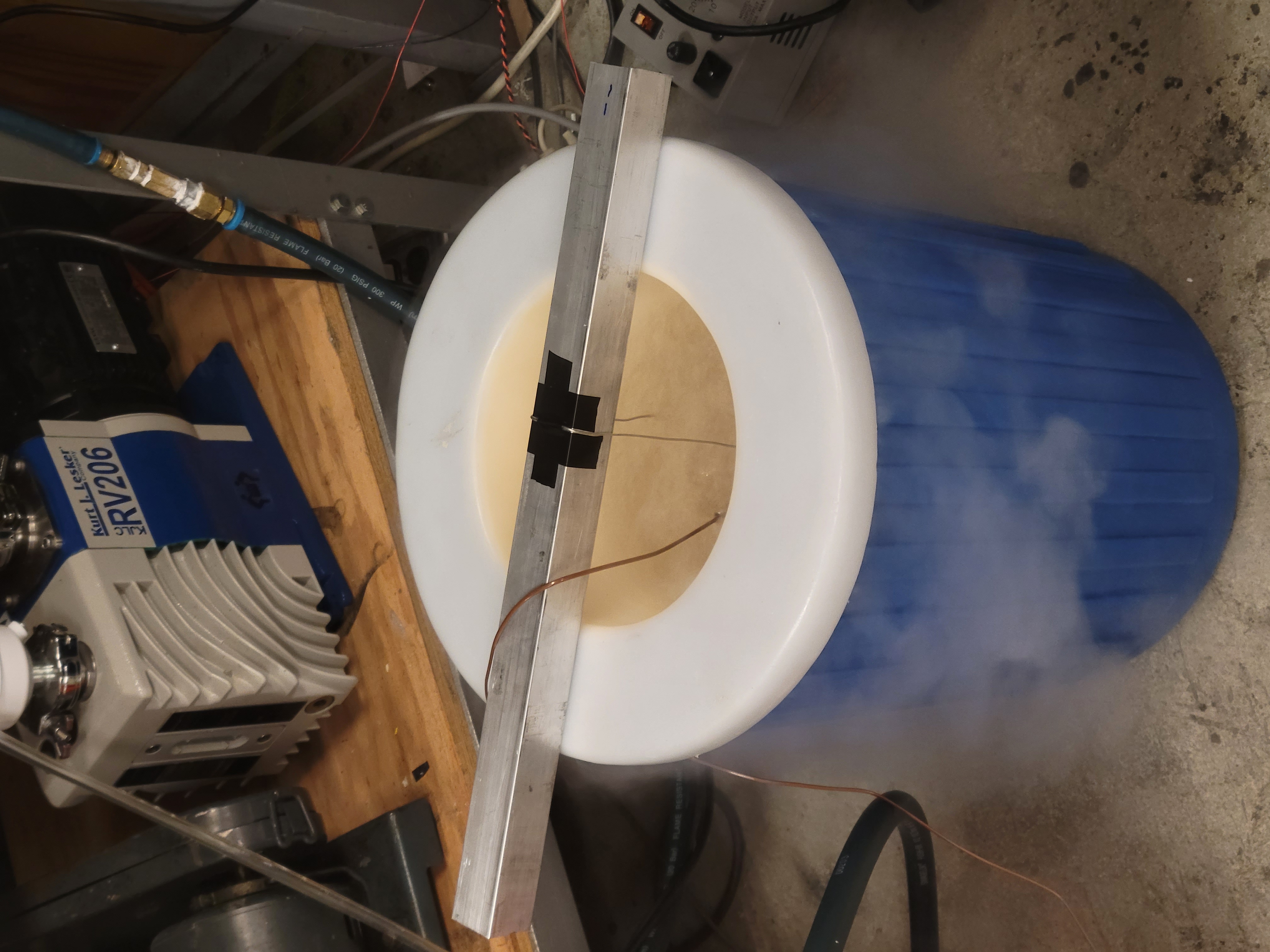
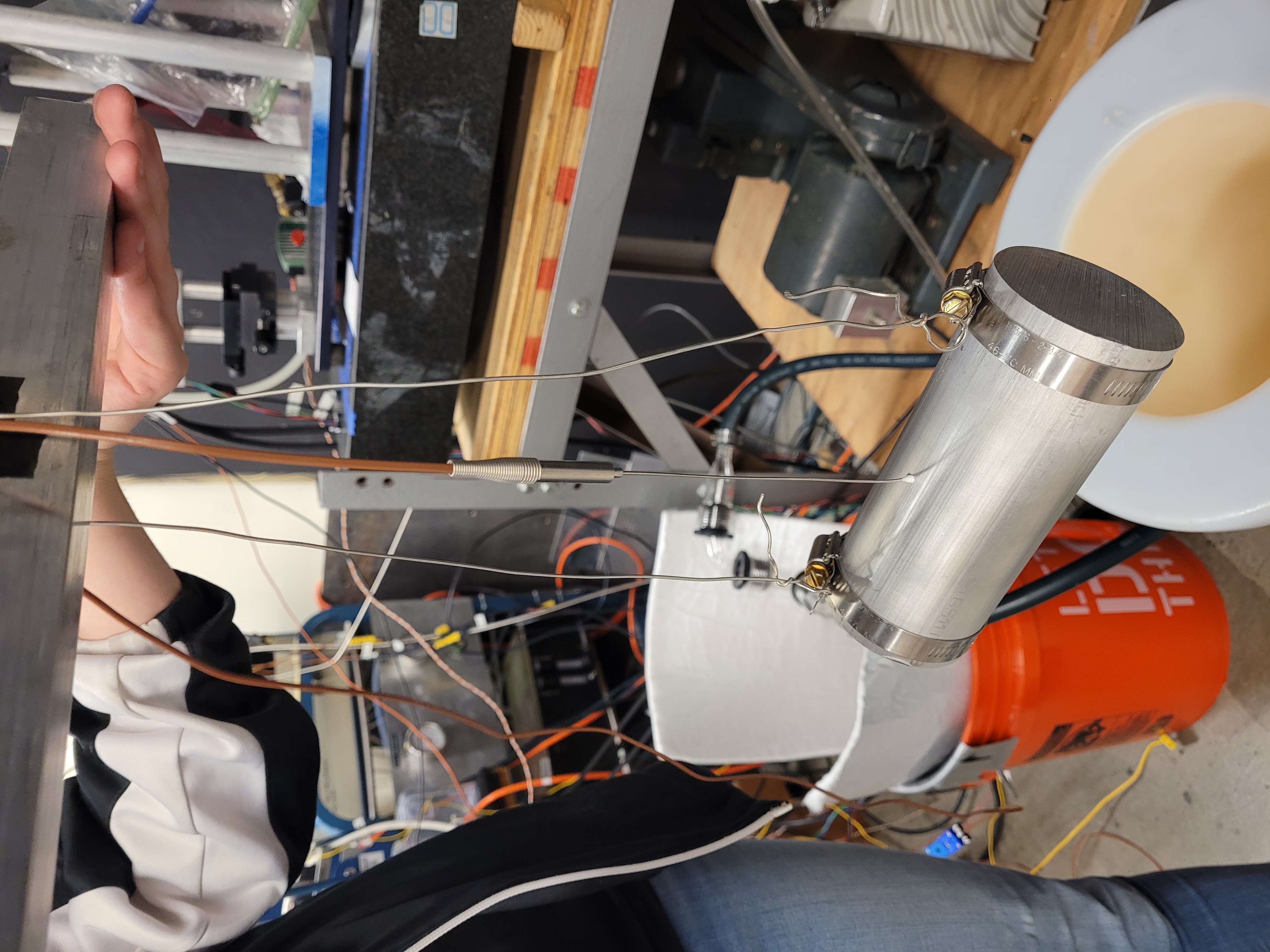
- - Conducted experimental research by immersing aluminum cylinders in liquid nitrogen to study boiling characteristics and heat transfer dynamics
- - Quantitatively measured temperature changes over time using thermocouples, providing insights into rapid cool-down times and heat flux during quenching
- - Contributed to enhancing understanding of cryogenic propellants for long-term space travel through comparative analysis with existing published data
- 1. Cryogenic Team Charlie's Final Report: Here
- 2. Cryogenic Team Charlie's Proposal Report: Here
- 3. Cryogenic Team Charlie's Manufacturing Report: Here
Theory / Analysis
-
This section analyzes heat transfer dynamics and the cooling process of aluminum cylinders in liquid nitrogen.
- Initial room temperature: 298 K (25°C), liquid nitrogen temperature: 77 K (-196°C).
- Biot number (Bi) calculated to assess convective heat transfer's impact using Equation 2.
- Biot number of 9 indicates significant convective heat transfer influence.
- Using "Heat Transfer: A Practical Approach" by Yunus A. Cengel, the cool-down time is calculated to be about 6.5 minutes.
-
Calculation details:
- Equation 2: Biot number calculation: \( \text{Bi} = \frac{h r}{k} = 9 \) implies \( h = 70015 \, \text{W/m}^2\text{K} \).
- Equation 3: Thermal diffusivity (\( \alpha \)): \( \alpha = \frac{k}{\rho c_p} = 9.7 \times 10^{-5} \, \text{m}^2/\text{s} \).
- Equation 4: Relationship between temperatures and time constant (\( \tau \)): \( \frac{T_i - T_\infty}{T_s - T_\infty} = A_1 e^{-\lambda_1^2 \tau} \) where \( \tau = 0.18819 \).
- Equation 5: Cool-down time calculation: \( t = \frac{\tau V}{\alpha} = 393 \, \text{seconds} \) (approximately 6.5 minutes).
-
Insights into cooling dynamics:
- Heat conduction and convective heat transfer equations are explored to understand cooling dynamics.
- Thermal properties like mass, volume, density, and specific heat capacity of the aluminum cylinder are considered.
- Thermal diffusivity (\( \alpha \)) is defined and crucial for determining temperature changes over time.
- The mass of the cylinder is calculated: \( m = \rho \pi r^2 L = 5.1835 \, \text{kg} \).
- Maximum heat transfer (\( Q_{\text{Max}} \)) is calculated: \( Q_{\text{Max}} = m c_p (T_i - T_\infty) = 674.024 \, \text{kJ} \).
-
Experimental validation:
- Theoretical predictions based on heat transfer equations are compared with experimental data.
- Validates the accuracy of the experimental setup and refines understanding of cooling dynamics.
Nomenclature:
- Bi: Biot number
- h: Heat transfer coefficient (W/m²K)
- k: Thermal conductivity (W/mK)
- r: Radius (m)
- \( \alpha \): Thermal diffusivity (m²/s)
- \( \rho \): Density (kg/m³)
- c_p: Specific heat capacity (J/kgK)
- T_i: Initial temperature (K)
- T_\infty: Ambient temperature (K)
- T_s: Surface temperature (K)
- \( \tau \): Time constant
- V: Volume (m³)
- m: Mass (kg)
- Q_{\text{Max}}: Maximum heat transfer (kJ)
Design of Testing Cylinders
- - The focus was on creating an effective yet practical design for testing cylinders. The design needed to provide necessary data for hypothesis evaluation while being feasible for manufacturing.
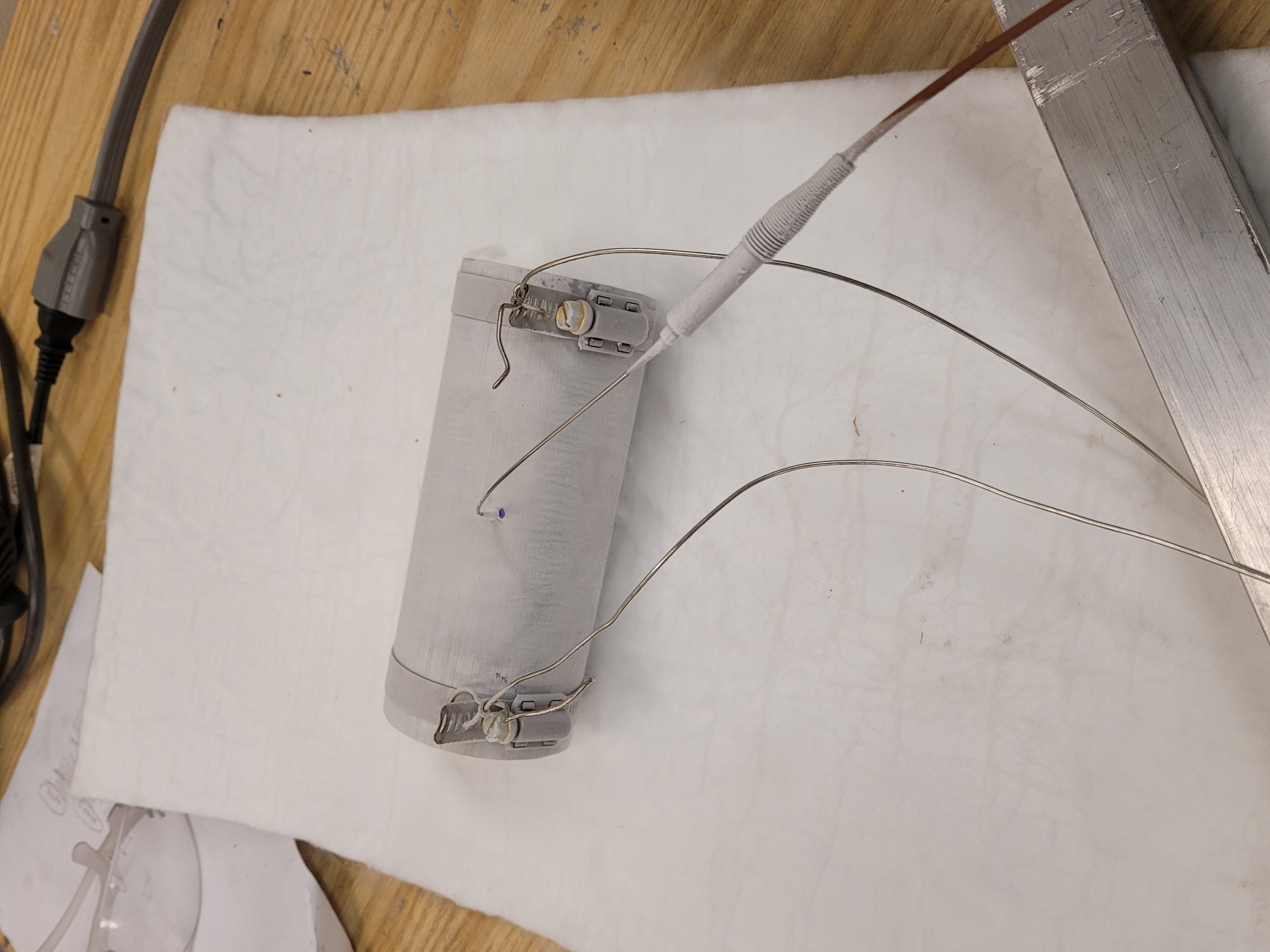
- - Two cylinders were designed: Cylinder 1 served as the baseline measurement, while Cylinder 2 measured the heat flux of liquid nitrogen. Thermocouples were inserted into specific points for temperature measurement.
- - Precise drilling of holes for thermocouple insertion was crucial. Soft jawed clamps and mills were used for accuracy. Cylinder 1 required one hole, while Cylinder 2 needed two holes for thermocouple placement.
- - The project timeline was divided into design, manufacturing, testing, and analysis phases. Challenges arose in cool-down time calculations, sourcing materials, and unexpected difficulties in manufacturing. Member-specific roles and a detailed budget were outlined, with a focus on conservation due to budget constraints.
- - Overall, meticulous planning and adaptation were essential to overcome challenges and execute the project within the allotted timeframe and budget.
Testing Objectives
-
Cryogenic Boiling Team 1 (Charlie):
- Deepening understanding of liquid nitrogen cooling by placing thermocouples along spheres' radius to measure temperature gradients.
- Addressing inconsistency from nitrogen vapor envelope by measuring temperatures within the cylinder's surface plane.
- Analyzing temperature gradients across spheres to enhance precision using the heat transfer equation.
- Improving uncertainty analysis for cryogenic propellant storage and transfer systems.
-
Testing Process:
- Dipped aluminum cylinders in liquid nitrogen, monitored temperature shifts with thermocouples.
- Cylinder 1 focused on core temperature change; Cylinder 2 measured core and surface temperatures.
- Monitored temperature gradient and cooling time to 2% of liquid nitrogen's temperature (about 77 Kelvin).
- Considered factors like liquid nitrogen temperature, cylinder size, container conditions.
- Recorded room temperature, liquid nitrogen depth, and maintained consistent initial volume.
- Varied cylinder hole configurations to test impact on cooling rates.
- Detailed procedures and parameters in Appendices E and F for further insights.
Results and Discussions
- In this experiment, we explored heat transfer and boiling dynamics at extremely low temperatures using two cylinders:
- Cylinder 1: Average cooling time of 382 seconds.
- Cylinder 2: Average cooling time of 310 seconds, 21% faster than expected.
- The setup differences:
- Cylinder 1 had a central hole.
- Cylinder 2 had an additional hole halfway to the surface.
Conclusions
-
The project focused on studying heat transfer and cooling using liquid nitrogen, crucial for handling cryogenic propellants. Researchers:
- Immersed aluminum cylinders in liquid nitrogen to measure cooling times and heat flow.
- Observed one cylinder cooled in 390 seconds, matching expectations.
- Found another cylinder, with more measurements, cooled 21% faster, potentially due to surface irregularities.
-
Experimental data generally aligned with predictions but showed discrepancies with published sources. Future research suggestions:
- Use improved equipment and techniques for better accuracy.
- Test various shapes and materials to optimize heat transfer.
- Refine temperature-to-heat flux calculations for more precise results.
- Propose projects to compare different materials and shapes, aiming for clearer data comparisons.
Photo Album